
Toscano Digital builds a high-traffic real estate portal with Blazor and .NET
Industry
Real Estate
Organization Size
Large (1,000-9,999 collaborators)
Country/region
Italy
Technology
Company
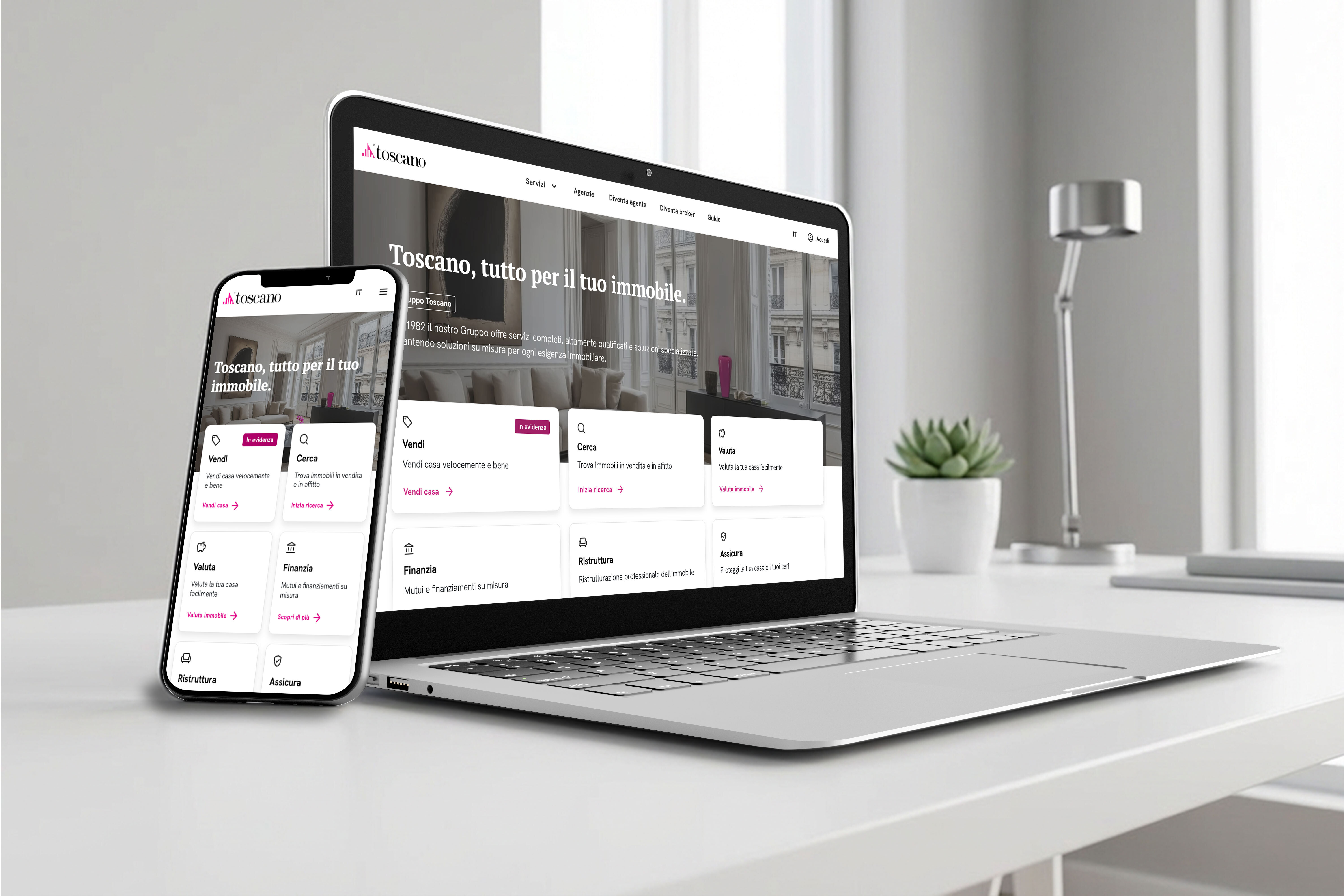
When Gruppo Toscano, one of Italy's leading real estate franchisors, needed to reimagine its public-facing portal for millions of home buyers and sellers, the company turned to its in-house technology team. Toscano Digital, the group's technological arm, designs and manages the entire digital ecosystem for a network offering real estate brokerage, credit, renovations, and insurance services across Italy.
What makes Toscano Digital's story remarkable is the scale of what a small team accomplished. With just five developers and a deep commitment to .NET, the team built a high-traffic consumer portal that now serves 4.6 million sessions and handles 11 million page views annually.
Modernizing for millions of users
Toscano Digital has been a .NET shop since 2014. In 2020, the team made an early bet on Blazor WebAssembly for the second version of their mission-critical B2B CRM, used daily by roughly 1,000 collaborators across the Gruppo Toscano network. That migration from .NET Framework and jQuery to Web API and Blazor WebAssembly was a major success, delivering faster feature velocity and dramatically simpler maintenance.
But when the time came to rebuild the group's public-facing portal, a B2C site where millions of Italians search for homes, the stakes were different. The new site needed to be optimized for SEO, since organic search is the primary driver of traffic for real estate listings. It needed to load fast on mobile devices. And it needed to handle unpredictable traffic spikes.
The conventional approach would have been to hire a separate front-end team specializing in React, Next.js, or Vue. Toscano Digital evaluated those options, but CEO Pietro Montelatici saw a different path. "Adopting a JavaScript framework would have required fragmenting our team's skill sets and creating a more complex management of shared business logic," he explains. "For a lean team like ours, being able to use the same language on both the back end and front end is an unbeatable productivity multiplier."
The team chose to go all-in on Blazor for both the internal CRM and the public-facing portal, betting that .NET 10's server-side rendering capabilities could deliver the SEO and performance a high-traffic consumer site demands.
A "Neutral SSR" architecture for SEO and speed
To meet their search engine optimization (SEO) requirements while preserving the rich interactivity their users expect, Toscano Digital designed a layered architecture that blends static server-side rendering with WebAssembly hydration:
- Static SSR: Using .NET 10's static server-side rendering, pages are rendered on the server and delivered as fully formed HTML that search engines can index instantly.
- Edge caching: The rendered HTML is deliberately "neutral," stripped of user-specific personalization, so that Cloudflare can cache it at the edge for sub-second delivery worldwide. Cache purging is automated through GitHub Actions on each deployment.
- WASM hydration: Once the initial page loads, Blazor WebAssembly takes over to provide interactivity and personalization. User-specific data like saved searches and account details are loaded via API after the initial render.
This approach gives Toscano Digital the best of both worlds: search engines see fully rendered content, while users get a fluid, app-like experience once the page is interactive.
PersistentComponentState: a streamlined handoff
One of the trickiest aspects of combining server-side rendering with client-side interactivity is the handoff between the two. When Blazor WebAssembly takes over from the server-rendered page, the application state needs to transfer seamlessly without redundant API calls or visible flicker.
In .NET 10, Blazor introduced the [PersistentState] attribute, which dramatically simplifies the process. For Toscano Digital, this improvement was transformative.
PersistentComponentState is much more than a feature; it provides a solid and reliable foundation for the server-to-client handoff that traditional methods lacked, making Blazor the truly rational choice for high-scale B2C."
The [PersistentState] attribute eliminated complex boilerplate code the team had previously written to manage state transfer manually. Compared to their earlier approaches, the declarative model provided a more robust and reliable mechanism, making the entire architecture significantly more maintainable.
Tuning for the "last mile" on mobile
With the core architecture in place, Toscano Digital turned its attention to mobile performance. Desktop results were strong, with a First Contentful Paint of just 0.6 seconds. But Total Blocking Time on mobile devices exceeded one second, caused by the WebAssembly runtime boot and hydration phase.
The team worked extensively to optimize the experience, experimenting with AOT compilation and assembly trimming strategies. Their tests revealed nuanced trade-offs: while ahead-of-time compilation improved execution speed, it could increase initial parsing time on mobile devices. Working directly with Microsoft's Blazor engineering team, Toscano Digital explored advanced loading strategies such as delaying WebAssembly initialization until user interaction is required, improving perceived performance without sacrificing functionality.
The results speak for themselves. Thanks to the new architecture, average server response time dropped from 200 milliseconds to just 30 milliseconds, an 85% improvement.
A true full-stack team
With .NET 10 and Blazor, we have broken down the wall between front end and back end, allowing a small team of 5 to manage large-scale, complex products."
For Montelatici, the biggest impact of choosing .NET has been organizational. With a single language and framework spanning the entire stack, there are no barriers between the developers building back-end services and those creating the user interface. Everyone on the five-person team can work on any part of the system.
This has drastically reduced communication overhead and integration errors, the kind of friction that slows down larger, siloed teams. Features move from idea to production faster, and the team can respond to business needs without waiting for specialists.
Beyond C#, the team relies on .NET features like Pattern Matching for managing complex URL routing logic and LINQ for data manipulation. Montelatici describes both as indispensable for keeping code clean and expressive across a large codebase.
Built on Azure and GitHub
Toscano Digital's infrastructure runs entirely on Microsoft Azure, including App Service, Azure Functions, Azure SQL, Service Bus, Blob Storage, Logic Apps, and Microsoft Foundry for AI-powered features in their B2B CRM, such as rewriting property descriptions and suggesting communication strategies for agents.
The full software lifecycle is managed through GitHub with GitHub Actions powering CI/CD pipelines, including the automated Cloudflare cache purging that keeps their edge-cached content fresh after every deployment.
Real-world results
The new portal launched in early March 2026, and the results exceeded expectations:
- Server response time: 200ms → 30ms (85% reduction)
- First Contentful Paint: 0.6 seconds on desktop
- New user accounts: Nearly 100,000 created in the first three weeks
- Traffic handling: Unexpected traffic spikes managed seamlessly through the combination of Azure and SSR
The project was successfully unveiled during Gruppo Toscano's national roadshow to over 600 members of the commercial network, confirming that .NET technology is ready to support the group's growth ambitions and digital transformation.
Transparency that builds trust
Among the portal's features, the one Toscano Digital is most proud of is the Personal Area. Customers can monitor every phase of the buying or selling process in real time, 24 hours a day: property view statistics, scheduled appointments, received leads, and the specific media channels being used to market their listings.
The power of .NET allows us to transform the complexity of the real estate market into a fluid, transparent, and fast user experience."
This total transparency has strengthened the bond of trust between Toscano's agencies and their customers, turning a technology investment into a competitive advantage in Italy's real estate market.
Looking ahead
Toscano Digital's journey, from early Blazor adopter to delivering a high-scale consumer portal with a five-person team, demonstrates what's possible when a lean team commits to a unified technology stack. By choosing .NET and Blazor over a fragmented multi-framework approach, they turned a constraint into a strength: one language, one team, and one architecture serving millions of users.
With plans to expand AI-powered features for their agent network and continued investment in performance optimization, Toscano Digital is proving that .NET is not just a back-end technology. It's a full-stack platform ready for the most demanding consumer experiences.